Chief Adedayo Adekunle who lives in Lekki lagos nigeria believes so much in reinvention.
In Lekki Lagos, reinvention was not a crime; it was survival. Men arrived with nothing but a nylon bag and a stubborn hunger, and if they were fortunate or ruthless they returned years later wrapped in imported suits and new accents.
Lagos did not ask where you came from. It only demanded proof that you had risen.
Adedayo had risen.
His house in Lekki stood behind tall gates and trimmed hedges shaped like obedient animals. Italian tiles gleamed beneath chandeliers.
Oil paintings of anonymous landscapes hung on the walls, suggesting travel and taste. Every object in the house testified to distance distance from mud roads, distance from darkness, distance from the boy who once waded into a brown river to set fishing traps before school.
He preferred to remember himself as self-made.
His wife, Morenike, completed the architecture of his new life. Educated in Ibadan and polished in London, she moved through charity dinners with controlled grace.
Together, they chaired the Blue Orchid Cultural Foundation, an organization located in lekki dedicated to “preserving African heritage while promoting global excellence.”
The irony of that mission never troubled him.
Among their circle lawyers, consultants, politicians, bankers heritage was something to curate carefully.
It was drums at a festival, not hunger in a hut. It was Ankara on a runway, not a patched wrapper in a farmstead.
When asked where he grew up, Chief Adekunle would smile lightly and reply, “In the countryside. Humble beginnings.”
He never named the village.
The village was called Igbore.
It lay near the bend of the Ogun River, where the water curved like a patient arm around low, stubborn earth.
In the rainy season, the river swelled and turned violent. In the dry season, it shrank, exposing cracked mud and stranded fish.
That was where Adedayo, son of Bamidele the palm-wine tapper, had been born.
He had been a bright boy. Teachers praised him. Elders shook their heads with admiration and said he would not die in the village.
At twenty-two, newly certified as a primary school teacher, he married Ibidun.
The ceremony was small but proper. Kola nuts were broken. Elders invoked ancestors. Ibidun’s mother wept in restrained pride. They slaughtered a goat they could barely afford.
Ibidun was not educated beyond basic reading. She had strong arms, steady eyes, and a laugh that made other women turn to look. She believed in Adedayo with a faith that bordered on foolishness.
When he spoke of Lagos, she listened as if he were describing heaven.
“They say buildings touch the sky,” he had told her once, staring toward the river as though Lagos might appear beyond it. “They say if you work hard, you can become anything.”
“And you will become something,” she replied simply.
He liked that about her her certainty.
Two years into their marriage, he announced he was leaving.
“I will go first,” he said. “I will find work. When I am established, I will send for you.”
She did not hesitate. She sold her mother’s gold beads her only inheritance to fund his transport and first months in the city.
“Before the river dries,” he promised her, holding her face between his hands, “I will return for you.”
The river never dried.
HOW I WAS ALMOST SCA*MED IN LAGOS BY MY FRIEND GIRL FRIEND IN 2026
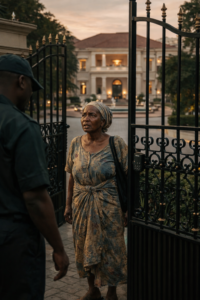
The woman who stood at the gate in Lekki decades later carried no gold beads.
Her wrapper was faded blue, the pattern nearly erased by years of washing. Her slippers were thin. A small bag hung from her shoulder, containing two changes of clothes and a plastic bottle of water.
Her name was Ibidun.
The gatekeeper eyed her with suspicion. “Who are you looking for?”
She squinted at the large house beyond the gate.
“Adedayo. Son of Bamidele.”
The gatekeeper frowned. “There is no one like that here.”
She held her ground. “This is his house.”
He hesitated, then asked for the surname.
“Adekunle,” she said carefully. She had learned it from a trader who had once shown her a newspaper clipping.
The gatekeeper’s posture shifted.
“You mean Chief Adekunle?”
She did not know the word “Chief” belonged to her husband now.
“Yes,” she answered.
“And what is your business?”
“I am his wife.”
The gatekeeper stared at her. Then he laughed softly, unsure if this was madness or audacity.
“Wait here,” he said.
When the house steward informed Chief Adekunle that an elderly village woman claimed to be his wife, the Chief felt something old and unwelcome stir in his chest.
He had buried Igbore long ago. He had buried the mud, the river, the promises made under a mango tree.
He had even buried the letters.
In the early years in Lagos lekki , he had written to Ibidun regularly. The city had not embraced him immediately.
He worked as a clerk in a shipping office, then as an assistant in a private school. He slept in a crowded room in Surulere.
Hunger was his friend But ambition sharpened him.
He noticed how lighter-skinned colleagues were treated with quiet deference. He observed how English spoken without hesitation opened doors. He adapted.
When he met Morenike at a professional networking event years later, he was already transforming. She admired his determination. He admired her connections.
He did not tell her about Ibidun.
By then, his letters home had grown infrequent. Then they stopped.
He told himself it was necessary. Lagos required sacrifice. The past had to be trimmed like excess fat.
Now the past had arrived at his gate.
“Give her money,” he instructed the steward. “Tell her she is mistaken.”
But Ibidun refused the envelope.
“I did not come for money,” she said calmly. “I came for my husband.”
Morenike noticed the tension before anyone spoke of it.
Her husband moved through the house that evening with unusual quiet. He avoided her eyes. When she asked if he was unwell, he dismissed it as fatigue.
“The foundation dinner is this Saturday,” she reminded him. “You must rest. Investors from Abuja are coming to lekki .”
He nodded.
The Blue Orchid Cultural Foundation dinner was not merely charity. It was positioning. Diplomats, corporate sponsors, cultural critics all would attend. The theme was “Heritage and Identity in a Global Age.”
Chief Adekunle was scheduled to deliver the keynote address.
Heritage.
Identity.
He almost laughed at the precision of fate.
The following day, Ibidun returned to the gate.
This time she sat on the pavement outside, unbothered by the sun. Neighbors drove past slowly, curious.
When security tried to move her, she said only, “Tell him I will wait. I have waited before.”
By afternoon, a small crowd had gathered.
The Chief could not risk a spectacle.
“Bring her to the guest quarters,” he ordered reluctantly.
They faced each other after twenty-eight years.
Time had altered them unevenly.
Adedayo had grown heavier, softer in places where wealth settles. His skin was lighter, maintained by indoor living. His hair was trimmed, his beard styled.
Ibidun’s face bore fine lines like cracks in dry earth. But her eyes were unchanged.
She looked at him without accusation.
“You are well,” she said.
He swallowed. “Why are you here?”
“You promised.”
The simplicity of her answer unsettled him.
“I sent money,” he said defensively.
“Not to me.”
He had sent money once or twice through a distant cousin, unsure if it ever arrived. It had been easier to stop.
“You married again,” she continued, not as a question.
He did not respond.
“I am not here to fight,” she said. “I am old. I wanted to see the man I called husband before I die.”
Something tightened in his throat.
“You should not have come,” he said quietly.
“I sold my mother’s beads,” she reminded him. “I sold them because you said the future was waiting.”
Silence filled the guest room.
Outside, the city hummed, indifferent.
2026 (True Life Story)The Legend of Mami Water: Water Spirit Mysteries
Morenike discovered the truth from a housemaid.
At first she dismissed it as gossip. But when she confronted her husband, his silence confirmed everything.
“You were married?” she asked, her voice steady.
“Yes.”
“And you never thought to tell me?”
“It was long ago,” he replied. “A village arrangement. It meant nothing.”
“Nothing?” Her composure cracked slightly. “You stood before me in a church and took vows while another woman still called you husband.”
He said nothing.
“Does she want money?” Morenike asked finally.
“She says she wants nothing.”
“That is worse.”
Morenike understood society. A scandal could be managed if it was transactional. But a moral accusation one rooted in abandoned vows was unpredictable.
“What will you do?” she demanded.
The Chief did not answer.
On the morning of the foundation dinner, Ibidun requested to attend.
“I want to hear him speak about heritage,” she said.
Security refused.
She did not argue. Instead, she waited near the entrance as guests began to arrive that evening, dressed in lace and tailored suits.
Some noticed her. Most ignored her.
Inside the ballroom, chandeliers glowed over white tablecloths. Cameras flashed. Conversations floated in refined accents.
Morenike wore emerald silk and a diamond necklace. She smiled when required.
Chief Adekunle stepped onto the stage to applause.
He began his speech smoothly.
“Our heritage,” he said, “is the foundation upon which we build our future. We must honor where we come from, even as we embrace global excellence.”
The words sounded rehearsed.
Halfway through the speech, the ballroom doors opened.
Heads turned.
Ibidun entered slowly, escorted reluctantly by a junior security officer who had failed to stop her.
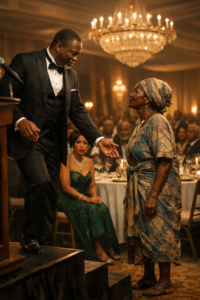
Her wrapper looked out of place among designer gowns. Her slippers made faint sounds against polished floors.
The hall fell into silence.
She walked forward until she stood several feet from the stage.
“Adedayo,” she said clearly.
The name struck the air like a stone.
Morenike’s hand tightened around her glass.
Guests glanced at one another.
The Chief felt every carefully built layer of his identity tremble.
“Adedayo, son of Bamidele,” Ibidun continued, her voice steady. “You promised to return before the river dried.”
There was no hysteria in her tone. No insult. Only memory.
He could deny her.
He could instruct security to remove her.
He could insist she was confused.
His mind calculated consequences rapidly: sponsors, headlines, reputation.
But beneath calculation, something older stirred—shame, perhaps, or fatigue from years of concealment.
He stepped away from the podium.
The microphone amplified the small sound of his breath.
“My name,” he said slowly, “is Adedayo, son of Bamidele.”
Gasps rippled through the room.
“This woman,” he continued, his voice no longer polished, “is the wife of my youth.”
Silence expanded.
“I left her in our village many years ago. I promised to return. I did not.”
He looked at Ibidun directly.
“I was ashamed of where I came from. I thought success required forgetting.”
Morenike felt the ground shift beneath her, but she remained seated.
“I built a new life,” he said. “But I built it on silence.”
The speech about heritage lay abandoned on the podium.
“I cannot speak of identity,” he concluded quietly, “while denying my own.”
He descended from the stage.
The aftermath was swift.
By morning, social media buzzed. Some praised his honesty. Others condemned his betrayal. Sponsors requested clarification. Journalists sought interviews.
Within the house, tension thickened.
Morenike confronted him privately.
“You humiliated me,” she said, not angrily but with cold precision.
“I told the truth.”
“Truth does not erase damage.”
He did not argue.
“What do you intend to do?” she asked.
He looked toward the guest quarters where Ibidun slept.
“I do not know,” he admitted.
Morenike studied him.
“For years,” she said, “I believed I married a man rising from hardship. Now I discover I married a man running from it.”
Her words landed harder than public criticism.
Ibidun requested to return to Igbore.
“I did not come to live here,” she said. “I came to see if the boy I married still existed.”
“And?” he asked.
She regarded him carefully.
“He is buried under many things. But he is not completely gone.”
The assessment was neither flattering nor cruel.
“Will you forgive me?” he asked.
She considered.
“I forgave you long ago,” she said. “Anger is heavy. I had work to do.”
He felt small before her steadiness.
“What will you tell the village?” he asked.
“That you are alive,” she replied. “That you remembered your name.”
Before leaving, she removed a small cloth bundle from her bag.
Inside were broken fragments of gold beads.
“I kept them,” she said. “Not because of you. Because they were my mother’s.”
She handed him one fragment.
“A reminder,” she said simply.
Months passed.
The scandal faded gradually, replaced by newer distractions.
Some sponsors withdrew; others remained. Public curiosity shifted elsewhere.
Morenike moved into a separate wing of the house. Conversations between them became measured negotiations.
One evening, she spoke plainly.
“I will not share my husband,” she said. “But I will not live in deception again.”
He nodded.
“I will establish a school in Igbore,” he said after a pause. “In my father’s name.”
She studied him, searching for performance. She found none.
“Do it,” she replied.
He traveled to the village for the first time in decades.
The river still curved patiently around the earth.
Children gathered to stare at the convoy of cars. Elders approached cautiously.
When he stood before the old mango tree, memories pressed against him.
Ibidun watched from a distance.
He addressed the village not as Chief Adekunle, but as Adedayo.
“I left without honoring my promise,” he said publicly. “I cannot undo that. But I can build something here that remains.”
Construction began months later.
In Lekki Lagos, Morenike attended fewer galas. She redirected her foundation’s mission toward rural education.
Their marriage did not return to its former ease. Something fragile had been exposed and could not be restored entirely.
But there was less pretense.
One afternoon, as they reviewed architectural plans for the new school, Morenike asked quietly, “If she had demanded to stay, what would you have done?”
He answered honestly. “I do not know.”
She accepted that.
Honesty, though costly, was cleaner than illusion.
Years later, at the opening ceremony of Bamidele Memorial Primary School in Igbore, Adedayo stood beside Ibidun and Morenike.
It was an unusual arrangement, but no one commented openly.
Children sang. Drums sounded. The river flowed in the background, unchanged.
When he addressed the crowd, he spoke without prepared notes.
“I once believed success meant erasing where I began,” he said. “I was wrong. A man who forgets his origin builds a house without foundation.”
He did not mention scandal or shame.
He did not mention broken promises.
But he held a fragment of gold bead in his pocket as he spoke.
After the ceremony, Ibidun approached him.
“You have done enough,” she said.
“It is not enough,” he replied.
She shook her head gently. “It is what you can do now.”
There was no romantic reconciliation, no dramatic reunion. Their lives had moved in different directions too long.
But there was acknowledgment.
And acknowledgment, though quieter than apology, was solid.
In Lekki, the chandeliers still glowed.
But Chief Adekunle no longer avoided naming Igbore when asked about his origins.
He spoke of the river without embarrassment.
He mentioned the mango tree.
He did not sanitize the past; he contextualized it.
The transformation was subtle, but it altered him.
Reinvention had once meant deletion.
Now it meant integration.
One dry season, years later, the Ogun River receded farther than usual. Villagers murmured that perhaps it would finally dry.
It did not.
It never had.
Promises, like rivers, rarely vanish entirely. They recede, they hide beneath mud, they wait.
Adedayo stood at its edge during a visit and watched the current move steadily.
“I thought if I crossed you,” he murmured to the water, “I would not have to return.”
The river offered no reply.
Behind him, children from the new school ran along the bank, their laughter sharp and bright.
The future he once chased blindly had circled back to its source.
He slipped the remaining fragment of gold bead into the river and watched it disappear beneath the surface.
Not as payment.
Not as absolution.
But as acknowledgment that what had been broken could not be restored to its original form only honored in its fragments.
And that, finally, was enough.